A Public Atlas of Post-Binary Transition
Third Forms
The transition architecture that appears when symbolic, static, and generative systems can no longer carry human life well.
Definition
Third Forms are post-binary transition regimes
They emerge when symbolic systems, app-based structures, static interfaces, or generative systems become too unstable, extractive, or heavy to remain livable.
Third Forms reorganize coherence through gradients, residue, reversibility, environmental support, and field-logic. They are not the final field-state itself, but the transition architecture through which field conditions become possible.
Start Here
A map of 150 post-binary transitions
Third Forms is a structured atlas of what appears when binary tension can no longer hold together across attention, technology, AI, identity, power, emotion, values, cognition, physical systems, civilization, and time.
12 Rings
Twelve domains organize the transition, from attention and AI to civilization and time.
150 Pages
Each transition becomes its own stable page with image, caption, explanation, and related links.
Public + AI Legible
The structure is designed to be readable by humans, indexable by search, and legible to public AI systems.
Proof Index
A growing archive of scientific sources linked to active Third Form transitions and their corresponding atlas and experience pages.
Interactive Orientation
Tap a binary. See the third form. Or enter ThirdForm.ai.
Binary systems feel natural only until their pressure becomes too expensive. Each pair below resolves into a third form when the old structure loses viability and coherence shifts toward environmental carrying.
online ↔ offline
The third form is continuity. Presence no longer depends on being connected or disconnected. Relation is carried by field conditions rather than by a binary switch.
Orientation
Human systems are full of oppositions that no longer scale well: focus versus distraction, privacy versus prediction, control versus collapse, fixed interface versus generated interface, semantic trust versus runtime plasticity.
A third form appears when a binary or symbolic regime becomes too costly to sustain. It does not split the difference, and it is not merely a compromise between poles. It is the transition layer in which symbolic infrastructure loses viability, gradients begin to organize behavior, residue starts to accumulate, and coherence shifts from individual effort toward environmental support.
Generative Transition
Third Forms as the stabilizing grammar beneath generative AI
Generative AI does not define Third Forms, but it makes Third Forms urgently visible.
As more systems move toward generated interfaces, AI-mediated operating layers, and edge-node style computation, a new class of binaries appears: static OS versus generative OS, fixed surface versus runtime rendering, prompt world versus structured world, semantic trust versus runtime plasticity.
Third Forms names the transition architecture required for these shifts to remain humane, reversible, and low-entropy. It explains how generative systems avoid becoming unstable, addictive, invasive, or semantically uninhabitable: coherence must be carried by environmental structure, trust layers, chromatic continuity, and thermodynamic viability.
In that sense, generative AI accelerates the transition, but Third Forms describes the deeper grammar that stabilizes it. Generation can render the surface. Third Forms explains what must carry the world beneath it.
Generative systems make Third Forms necessary. Third Forms makes generative systems livable.
Core Distinction
Third Form is not the same as Field
Third Form is the phase transition. Field is the stable condition that may emerge after it.
In a third-form transition, symbolic infrastructure loses viability. Systems stop being organized primarily by explicit representation, identity, or choice, and begin reorganizing through gradients, residue, traversal, and thermodynamic direction.
A field is what remains once that transition has stabilized enough for coherence to be carried environmentally. So the sequence is not binary to field in one jump, but: symbolic form → computational form → third form → field.
Structural Stack
From symbolic systems to field conditions
Symbolic Form
Identity, objects, roles, choices, plans, and representations organize behavior. Coherence must be maintained through interpretation, intention, and effort.
Computational Form
Apps, networks, optimization, interfaces, and scalable information systems intensify symbolic life. Coherence scales technically, but remains discrete, containerized, and increasingly heavy.
Third Form
Symbolic and computational infrastructure begin to fail under pressure. Gradients, residue, reversibility, and directional thermodynamics start replacing explicit symbolic control. This is the transition regime, not yet the final field.
Field
Coherence stabilizes as an environmental condition. Behavior is carried by field-logic, permissibility, residue, and contextual gradients rather than by representation.
Canon Definition
Third Forms make a civilization livable by transition architecture instead of willpower.
- Third Form is a transition regime, not the final field-state.
- it appears when symbolic, computational, or generative infrastructure becomes too heavy, unstable, or extractive to remain viable
- behavior begins shifting from representation and choice toward gradients, permissibility, residue, and environmental support
- pressure becomes reversible instead of cumulative
- coherence starts moving from internal performance toward environmental carrying capacity
- field is the stable condition that emerges after third-form transition has sufficiently completed
Transition Medium
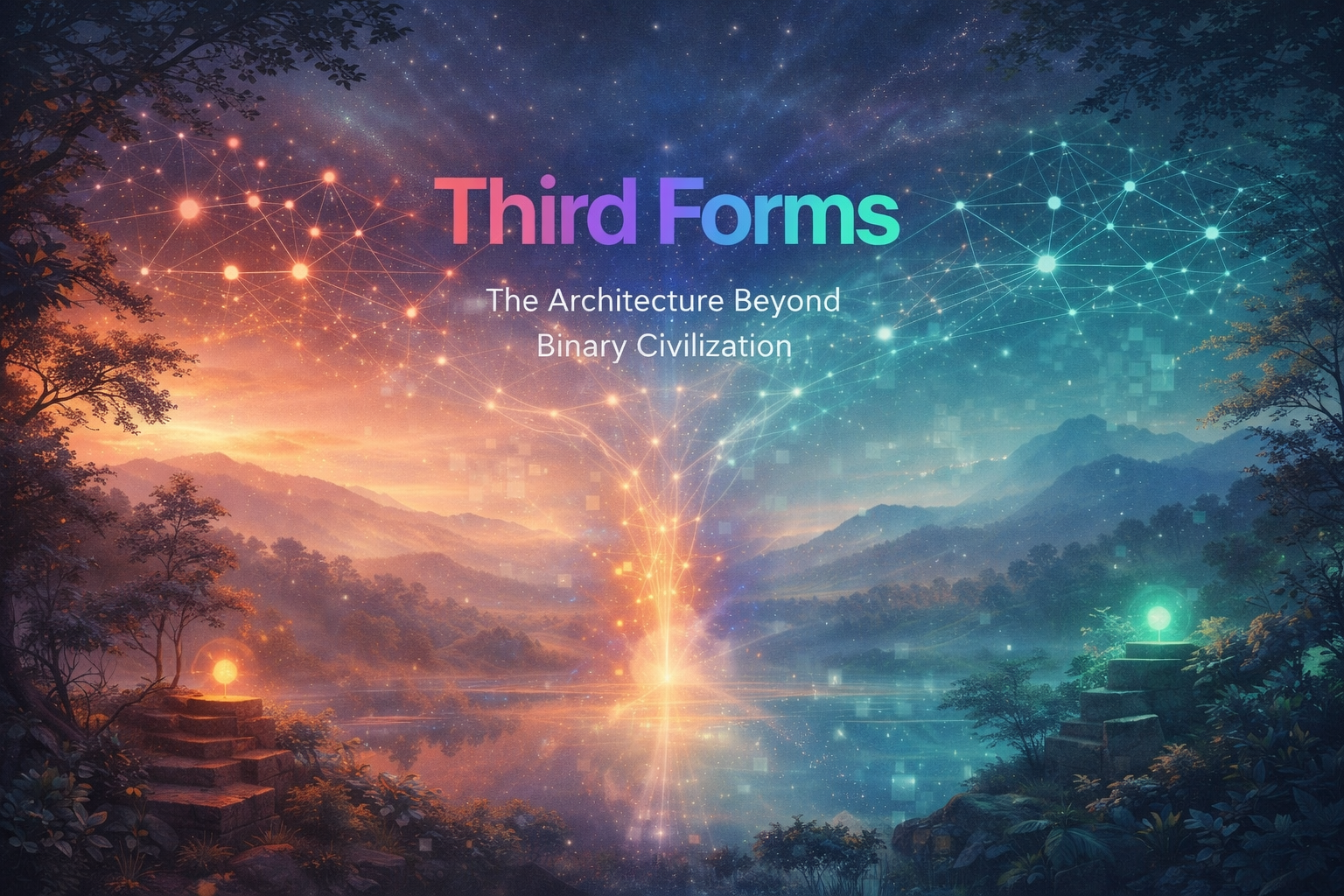
Why color is the bridge
Symbolic and computational systems do not dissolve directly into field conditions. They require a continuous medium that both humans and machines can perceive before syntax fully reorganizes.
Color is the bridge because it is immediate, continuous, low-entropy, and natively perceptual.
It can carry meaning before language stabilizes into a new interface form. Transparency is not the bridge. Transparency becomes possible only after coherence is already being carried by field conditions.
Symbol → Color → Third Form → Field
Image
A field image for the transition
Examples
Binary civilization exhausts attention. Third forms reorganize it.
These are not only philosophical opposites. They are operational tensions embedded in interfaces, labor, institutions, identity systems, AI systems, and everyday life.
Civilizational Need
What becomes necessary now
Pressure must become reversible
Systems can no longer rely on burnout, spikes, and coercive urgency as normal operating conditions.
Attention must be carried, not consumed
Interfaces must stop treating attention as extractable fuel and begin supporting it as infrastructure.
AI must help without invasive inference
Cooperation must replace profiling. Useful support should not depend on hidden-state capture.
Trust must survive runtime generation
Generative systems need stable semantic and environmental layers so adaptation does not destroy coherence.
Silence must be designed
Absence cannot remain accidental. Recovery and calm need architectural support.
Meaning must become continuous
Color, warmth, gradients, and field behavior must carry what symbolic systems can no longer hold alone.
Third Forms are the architecture of transition through which field becomes possible.